


A sample gives a buyer something to judge. The stand needs to help them see what they’re tasting, get close enough to try it and stay for a conversation about stocking it. If the person pouring has nowhere to put the bottle down, or the buyer can’t see the pack behind the cups, the furniture is getting in the way.
For a food or drink producer planning a trade show, that’s a useful starting point for the stand brief. Work through what happens around the samples before deciding how much counter space to order.
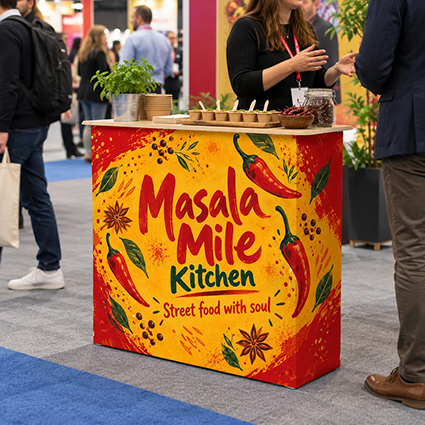
Show what goes with the sample
A spoonful of sauce doesn’t show a retailer the jar they’ll be buying. Keep a finished pack beside the tasting point, facing the visitor, rather than behind your serving equipment. With several flavours on offer, identify which sample belongs to which pack so nobody has to guess.
There is also a difference between tasting an ingredient and showing how it could be served. Meadow Vale’s IFE 2025 product feature paired its shredded chicken with menu ideas including loaded fries and nachos. That is a useful distinction for producers supplying foodservice. What does the buyer need to understand about using the product, as well as its flavour?
You don’t need to recreate a restaurant kitchen to answer that. A serving suggestion beside the pack may be enough. If the demonstration does need equipment, allow for its footprint before filling the rest of the stand.
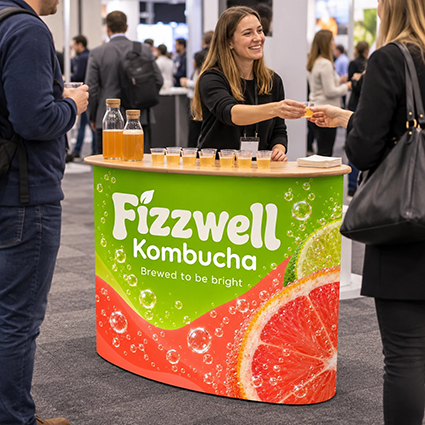
Give people somewhere to taste
Look at the counter from the visitor’s side. Can someone see what’s being offered and accept a sample without reaching over bottles, leaflets or your laptop? Is there room to pause while another visitor approaches?
A counter can work near an open edge, but its position depends on the stand’s open sides and how you serve. It doesn’t have to sit across the whole frontage. Try it nearer one end if that leaves a clearer approach, and keep the activity within your booked space rather than relying on the aisle for a queue.
Leave a little usable surface alongside the tasting point, separate from where you serve. Someone carrying a catalogue may need somewhere to put it down while looking at a pack. If every centimetre holds a tray, the counter looks ready for service but gives the buyer nowhere to stop.
Plan the work behind the counter
Serving a sample might mean opening a packet. It might mean cutting, mixing or heating. Those are different jobs, so don’t assume a branded counter gives you all the workspace you need.
Sketch where preparation happens, where the next batch waits and how someone reaches it. Keep replenishment behind the visitor-facing area where possible, so replacing an empty tray doesn’t involve carrying boxes through a conversation. Allow for waste and used serving items too, rather than finding somewhere for them after the first rush.
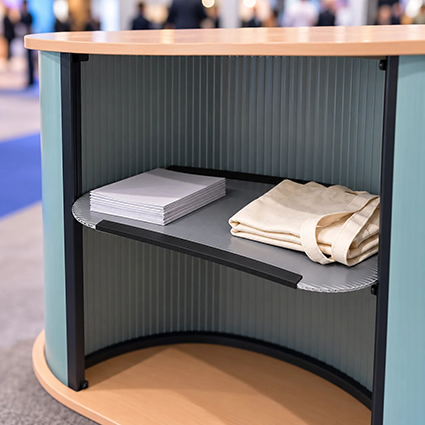
Among our promotional counters, the Basics Curved model has a rear storage opening and an optional internal shelf. That can give spare cups, napkins and paperwork a home away from the top. It isn’t a substitute for refrigeration or a preparation station. Check your product’s needs and the organiser’s current sampling requirements before settling the layout or ordering services.
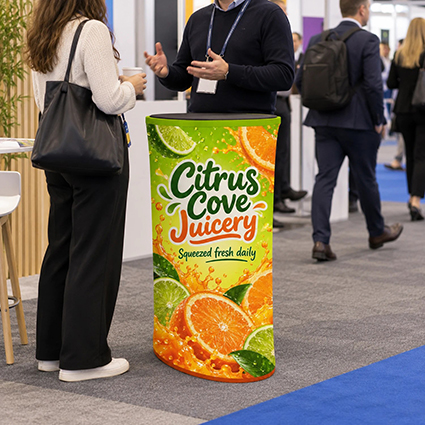
Leave room for the trade discussion
Once a buyer wants to talk about an order, they shouldn’t have to keep stepping aside for the next sample. Leave somewhere alongside the tasting point where you can show the pack and discuss supply without occupying the serving surface.
This doesn’t have to be a separate meeting area. On a compact stand, it could simply be the clear end of a counter with the trade information ready underneath. Keep case quantities, trade prices and ordering details accessible without spreading them across the tasting trays.
Where staffing allows, agree who takes over an interested buyer while sampling continues. If you’re exhibiting alone, make the information easy to reach with one hand and keep the offer manageable. A complicated tasting that needs your constant attention leaves little opportunity to find out what the visitor buys.
Try it with everything in place
Before the show, set out the actual packs, trays, cups and equipment against the dimensions of your chosen stand. Ask a colleague to approach, take a sample and ask about supply while you replenish it. That will reveal awkward reaches and blocked storage much faster than an empty floor plan.
When comparing exhibition stand kits, check the space left after the walls, feet and counter are in place. The backdrop and tasting furniture need to work together. A stand that photographs well empty still has to function once your team, products and buyers are on it.
Tom Watts is director of Stand Central, a UK supplier of exhibition stands, counters and display graphics.