


On a food production line, the first hygiene course is the easy part. The harder job is keeping every shift, agency worker and new supervisor at the same standard when the people on the line change from week to week.
Plenty of food manufacturers have the training paperwork in order. Where it tends to come apart is the night shift that missed the refresher, the temp who started on a Saturday, or the line leader who signs the checks without knowing why they matter. Here’s how I’d set it up so your food safety standards hold across every shift.
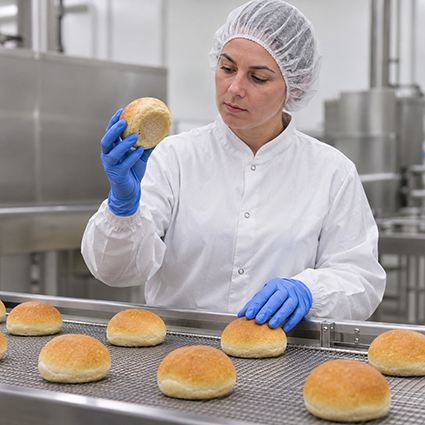
Start before anyone reaches the line
Many sites in the food industry rely on agency staff at peak times, and induction is where they pick up your standard, or don’t. A certificate from a previous job shows what someone learned elsewhere. It doesn’t show them your hygiene entrance, your colour-coded equipment or the high-care areas they can’t walk into.
Keep the first session short and run it at the start of their first shift, whatever time that is. Cover four basics of good manufacturing practice.
- How and when to wash and dry their hands at your basins, including after breaks, the toilet and handling waste.
- Protective clothing, hairnets and beard snoods, and your rules on jewellery, watches and phones in food handling areas.
- What they must report before a shift. The Food Standards Agency’s fitness to work guidance says staff with diarrhoea or vomiting should be kept away from open food, normally for 48 hours from when symptoms stop naturally.
- How you control foreign body contamination on their line, from detectable plasters to reporting damaged equipment.
The FSA also publishes a fitness to work questionnaire for new starters and visitors, which is easy to add to agency onboarding. Then watch each person do the handwash and changing routine before they touch product.
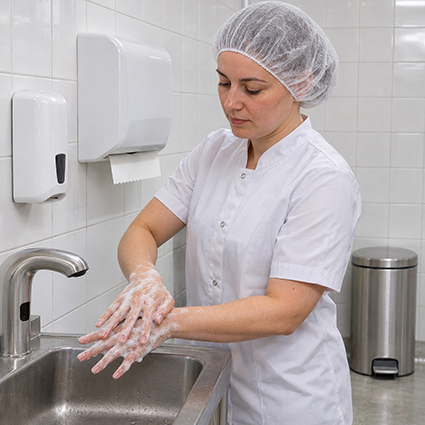
Train your team for the job on the line, not the job title
The law asks for food handlers to be supervised and instructed or trained in food hygiene in line with their work. Whoever develops and maintains your HACCP-based procedures needs adequate training in HACCP principles (Regulation 852/2004). That requirement gives you three groups to plan for.
- Operatives handling open product need food hygiene training matched to the hazards on their line, such as raw or ready-to-eat food, allergens and chilled food storage.
- Line leaders and supervisors need to understand what each food safety check controls, so they can spot poor practice and correct it there and then.
- Your HACCP team need enough knowledge to review the plan when a product, supplier or piece of equipment changes, so you keep producing safe food.
Fit food hygiene and safety training around the shifts
If refreshers only happen on weekdays at 10am, the night and weekend crews end up a step behind. Give every shift the same session, even if that means running it three times. Short briefings at changeover work well for anything new, like a changed allergen on a line or a cleaning problem found overnight.
Online learning helps because nobody waits for a classroom date. A supervisor on nights can learn at home or in a quiet spell, without losing a shift.

Where our online Level 3 training course fits in food manufacturing
Our Level 3 course is written with catering and retail food businesses in mind, and it suits smaller producers with a kitchen-scale unit, businesses that also run a café or shop or sample at shows, and supervisors who need the management side of food safety. If your customer’s standard names a particular qualification, check it with your auditor before you book.
Our online Level 3 course for supervisors covers HACCP, running a food safety management system, staff training and the role of a supervisor in 14 video units. Most people take about 6 to 7 hours, with no time limit. A place is £99.00 + VAT, or £79.00 + VAT each when you buy 25 or more.
The online assessment has an 80% pass mark and retakes are free. A Chartered Environmental Health Officer designed the course, it follows the CIEH and RSPH syllabus and the Institute of Hospitality endorses it.
Keep food safety records an auditor can follow
A BRCGS or SALSA auditor, or an Environmental Health Officer, will usually want to see that training is planned and checked, not just that certificates exist. A simple training matrix covers most of that compliance evidence. For each person, record their role and shift, what they were trained in, when, by whom, how you checked their understanding and when it’s due again.
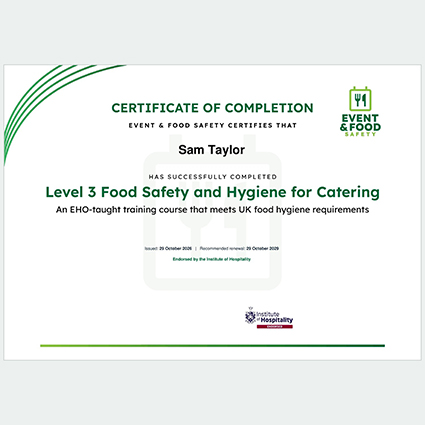
Put agency workers on the same matrix as your own staff. If someone moves from packing to high care, the record should show the extra training before the move. Each learner’s certificate from our courses carries a recommended renewal date, which keeps the matrix easy to update.
Refresh food safety training when something changes
Food hygiene certificates have no legal expiry date. We recommend refreshing every three years, but change is the better trigger. A new line, a new allergen on site, a recipe change, an audit finding or a near miss are all good reasons to retrain the people affected that week.
Tom Watts is director of Event & Food Safety, which has provided food safety advice for trade shows, exhibitions and events since 2007 and runs online Level 2 and Level 3 food hygiene courses.